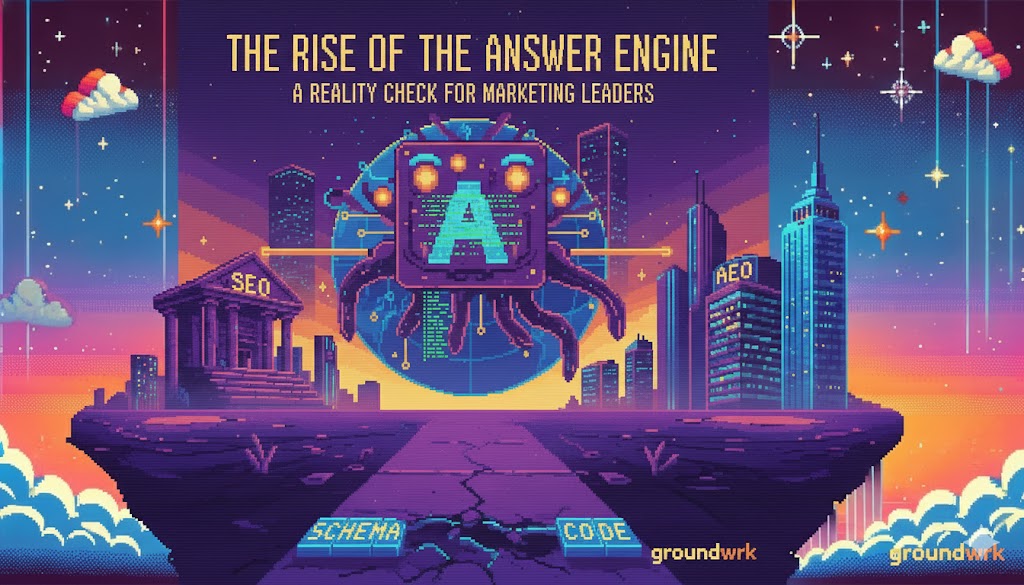
The Rise of the Answer Engine: A Reality Check for Marketing Leaders
Search is changing from a list of blue links into a conversation. This is the transition into the Answer Engine Optimization (AEO) era—where being cited by an AI model is becoming as critical as ranking on a results page.
Think about how you’ve been using the internet lately. You’re likely spending less time scrolling through an endless graveyard of search results and more time asking a chatbot for a specific recommendation. Whether it’s a “family-friendly SUV with actual soul” or the “best luxury hotel in Cherry Creek,” we are moving away from the era of the Search Engine and into the era of the Answer Engine.
For marketing leaders, this is a massive pivot. For years, the goal was to “win the click.” In 2026, the goal is to win the attribution. If ChatGPT or Gemini doesn’t mention your brand when a customer asks a relevant question, you’ve been edited out of the story.
First: The Fundamentals are Still the Bedrock
Before we look at what’s new, let’s get one thing straight: AEO is an evolution of SEO, not a replacement. You cannot charm an AI into recommending a broken, bloated website.
The same SEO pillars that have mattered for the last decade—site health, mobile performance, and high-quality content—are still the prerequisites for entry. AI models pull their information from the same digital gutters and goldmines that Google has been indexing for twenty years. If your site is slow, thin, or keyword-stuffed, you won’t just rank poorly; you’ll be filtered out of the conversation entirely. Think of traditional SEO as your ticket to the game; AEO is how you actually walk away with the trophy.
From SEO to AEO: A High-Level Map
Traditional SEO was built for a world where people typed “Denver web design” and clicked a link. AEO is built for a world where people ask “Who is the best Denver web designer for a custom SaaS build?” and expect a definitive answer.
While SEO focuses on keywords and page titles, AEO is about information gain and machine readability. AI models don’t just “read” your website; they digest it. They are looking for unique data, clear expertise, and a technical structure that allows them to extract your brand’s value and present it as a factual answer. At Groundwrk, we’ve found that the “full-service” agency approach of throwing more generic content at a problem doesn’t work anymore. AI is a quality filter.
The Cost of Inaction: The “Invisible” Tax
Here is the uncomfortable truth: if you ignore this shift, your customer acquisition cost (CAC) is going to skyrocket. When organic “Answer” traffic goes to your competitors, you’re forced to lean harder on paid search.
Paying $40 a click for a lead that doesn’t already trust you is a great way to set your Q4 budget on fire. We’re seeing a massive “invisible tax” being levied on brands with poor technical foundations. If an AI agent can’t verify your claims or parse your data, it simply moves on to a source it can trust. In 2026, being “un-parsable” is the same as being “un-findable.”
The Three Pillars of a Citation-Ready Site
To win in the age of the Answer Engine, your website needs to move beyond being just “pretty.” It needs to be useful. If a brand wants to be cited by AI, it generally needs to master these three things.
1. Technical Precision (The “No-Bloat” Rule) Most marketing leaders inherit sites built on heavy, generic templates that are basically the digital equivalent of a cluttered basement. These are noisy environments for AI. We build custom because it allows for a clean code-to-content ratio. When an AI crawler hits a site that isn’t bogged down by forty unnecessary plugins, it finds your brand’s message faster.
2. Structured Data (The Language of AI) If your website is a book, Schema Markup is the Table of Contents. This is a layer of code that tells search engines exactly what they are looking at: This is a service, this is a price, this is a verified client review. By speaking the native language of these models, you aren’t hoping they understand your value; you’re telling them.
3. Information Gain (The “So What?” Factor) AI models are trained to ignore repetition. If your blog posts look exactly like your competitor’s, an Answer Engine has no reason to cite you. We focus on “Information Gain”—original insights, proprietary data, and first-person case studies. To the AI, this is high-value fuel; to your customer, it’s proof that you aren’t just another voice in the crowd.
A High-Level Checklist for the C-Suite
If you’re wondering where your current site stands, ask your technical team these four questions. If the answer is “I’m not sure,” you have a problem.
- Does our site use JSON-LD Schema? (This is the specific dialect AI models prefer).
- Is our “Code-to-Content” ratio optimized? (AI shouldn’t have to dig through 5,000 lines of CSS to find one paragraph of text).
- Are we producing “Information Gain”? (Do we have original data or just a collection of “How-To” articles that ChatGPT could have written better?)
- Is our site “Entity-Validated”? (Does the web know who we are, or just what keywords we want to buy?)
Don’t Just Build for Today
The shift toward Answer Engines is the biggest change in digital marketing since the invention of the smartphone. You can’t rely on the strategies of the past to win the business of the future.